Read X Number of Lines After String Match Python
Python has a born string class named "str" with many handy features (there is an older module named "string" which you lot should not use). String literals tin be enclosed by either double or single quotes, although unmarried quotes are more than usually used. Backslash escapes piece of work the usual way within both single and double quoted literals -- e.m. \n \' \". A double quoted string literal can comprise single quotes without any fuss (e.thou. "I didn't do it") and likewise single quoted string can contain double quotes. A string literal can bridge multiple lines, but in that location must be a backslash \ at the end of each line to escape the newline. String literals inside triple quotes, """ or ''', can span multiple lines of text.
Python strings are "immutable" which means they cannot be changed after they are created (Java strings also use this immutable manner). Since strings can't be changed, we construct *new* strings equally nosotros go to represent computed values. So for instance the expression ('hello' + 'at that place') takes in the two strings 'hi' and 'there' and builds a new string 'hellothere'.
Characters in a string tin be accessed using the standard [ ] syntax, and like Java and C++, Python uses naught-based indexing, so if s is 'hello' s[one] is 'e'. If the index is out of bounds for the string, Python raises an error. The Python manner (unlike Perl) is to halt if it can't tell what to do, rather than just make up a default value. The handy "piece" syntax (below) also works to excerpt any substring from a string. The len(string) function returns the length of a string. The [ ] syntax and the len() function really work on any sequence type -- strings, lists, etc.. Python tries to make its operations work consistently across different types. Python newbie gotcha: don't use "len" as a variable proper name to avoid blocking out the len() function. The '+' operator tin concatenate ii strings. Notice in the code below that variables are non pre-declared -- just assign to them and go.
s = 'hullo' print s[one] ## i print len(s) ## 2 print s + ' in that location' ## hi in that location
Different Coffee, the '+' does non automatically convert numbers or other types to string class. The str() role converts values to a string form so they can be combined with other strings.
pi = 3.fourteen ##text = 'The value of pi is ' + pi ## NO, does not work text = 'The value of pi is ' + str(pi) ## aye
For numbers, the standard operators, +, /, * piece of work in the usual manner. There is no ++ operator, but +=, -=, etc. work. If you want integer division, it is nigh right to use 2 slashes -- e.k. 6 // 5 is 1 (previous to python 3, a unmarried / does int division with ints anyway, simply moving forward // is the preferred fashion to signal that you want int division.)
The "print" operator prints out one or more than python items followed past a newline (leave a trailing comma at the end of the items to inhibit the newline). A "raw" cord literal is prefixed past an 'r' and passes all the chars through without special treatment of backslashes, so r'x\nx' evaluates to the length-4 string 'x\nx'. A 'u' prefix allows y'all to write a unicode string literal (Python has lots of other unicode back up features -- see the docs beneath).
raw = r'this\t\n and that' # this\t\n and that print raw multi = """It was the best of times. Information technology was the worst of times.""" # Information technology was the all-time of times. # It was the worst of times. print multi
String Methods
Here are some of the almost common string methods. A method is similar a office, simply it runs "on" an object. If the variable s is a string, and then the code s.lower() runs the lower() method on that string object and returns the outcome (this idea of a method running on an object is i of the bones ideas that make up Object Oriented Programming, OOP). Here are some of the most common string methods:
- s.lower(), s.upper() -- returns the lowercase or capital letter version of the string
- due south.strip() -- returns a string with whitespace removed from the kickoff and finish
- s.isalpha()/s.isdigit()/s.isspace()... -- tests if all the string chars are in the various character classes
- s.startswith('other'), southward.endswith('other') -- tests if the cord starts or ends with the given other string
- s.notice('other') -- searches for the given other cord (not a regular expression) within south, and returns the offset alphabetize where it begins or -one if non found
- south.replace('old', 'new') -- returns a string where all occurrences of 'quondam' have been replaced by 'new'
- due south.split up('delim') -- returns a list of substrings separated by the given delimiter. The delimiter is not a regular expression, it's just text. 'aaa,bbb,ccc'.divide(',') -> ['aaa', 'bbb', 'ccc']. Every bit a convenient special case s.split() (with no arguments) splits on all whitespace chars.
- south.join(listing) -- opposite of split(), joins the elements in the given list together using the string as the delimiter. e.g. '---'.join(['aaa', 'bbb', 'ccc']) -> aaa---bbb---ccc
A google search for "python str" should lead you to the official python.org string methods which lists all the str methods.
Python does non accept a split up character type. Instead an expression like south[8] returns a string-length-1 containing the character. With that cord-length-i, the operators ==, <=, ... all work as you would expect, so generally yous don't need to know that Python does non have a separate scalar "char" type.
String Slices
The "slice" syntax is a handy way to refer to sub-parts of sequences -- typically strings and lists. The slice due south[kickoff:finish] is the elements showtime at start and extending upwardly to simply not including end. Suppose we accept s = "Hello"
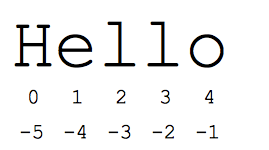
- southward[1:4] is 'ell' -- chars starting at index i and extending up to but not including index four
- southward[1:] is 'ello' -- omitting either index defaults to the starting time or end of the string
- southward[:] is 'Hullo' -- omitting both always gives u.s. a copy of the whole thing (this is the pythonic way to copy a sequence similar a string or list)
- southward[ane:100] is 'ello' -- an index that is besides large is truncated down to the cord length
The standard zero-based index numbers give piece of cake access to chars virtually the get-go of the string. Equally an culling, Python uses negative numbers to give piece of cake access to the chars at the end of the string: south[-1] is the last char 'o', due south[-2] is 'fifty' the next-to-last char, and then on. Negative index numbers count back from the cease of the string:
- s[-1] is 'o' -- last char (1st from the stop)
- due south[-4] is 'e' -- 4th from the end
- s[:-3] is 'He' -- going upwards to but not including the final 3 chars.
- s[-three:] is 'llo' -- starting with the 3rd char from the end and extending to the cease of the cord.
It is a peachy truism of slices that for whatever alphabetize n, due south[:due north] + s[north:] == s. This works even for n negative or out of bounds. Or put another way s[:n] and due south[due north:] always partition the string into two cord parts, conserving all the characters. Every bit we'll see in the list section subsequently, slices work with lists too.
String %
Python has a printf()-like facility to put together a string. The % operator takes a printf-type format string on the left (%d int, %s cord, %f/%g floating point), and the matching values in a tuple on the right (a tuple is made of values separated by commas, typically grouped inside parentheses):
# % operator text = "%d little pigs come out, or I'll %south, and I'll %s, and I'll blow your %s down." % (three, 'huff', 'puff', 'business firm')
The above line is kind of long -- suppose you lot desire to break it into separate lines. You lot cannot just split the line after the '%' equally yous might in other languages, since by default Python treats each line equally a separate argument (on the plus side, this is why we don't need to type semi-colons on each line). To fix this, enclose the whole expression in an outer gear up of parenthesis -- and so the expression is immune to bridge multiple lines. This code-across-lines technique works with the diverse group constructs detailed below: ( ), [ ], { }.
# Add parentheses to make the long line work: text = ( "%d little pigs come out, or I'll %south, and I'll %s, and I'll blow your %s downwardly." % (iii, 'huff', 'puff', 'business firm'))
That's ameliorate, but the line is still a little long. Python lets y'all cutting a line up into chunks, which information technology will and so automatically concatenate. And then, to make this line even shorter, nosotros can do this:
# Split the line into chunks, which are concatenated automatically by Python text = ( "%d little pigs come out, " "or I'll %s, and I'll %s, " "and I'll blow your %s down." % (3, 'huff', 'puff', 'house'))
i18n Strings (Unicode)
Regular Python strings are *not* unicode, they are just plain bytes. To create a unicode string, employ the 'u' prefix on the cord literal:
> ustring = u'A unicode \u018e string \xf1' > ustring u'A unicode \u018e string \xf1'
A unicode string is a different type of object from regular "str" string, only the unicode string is uniform (they share the mutual superclass "basestring"), and the various libraries such as regular expressions work correctly if passed a unicode string instead of a regular string.
To catechumen a unicode string to bytes with an encoding such as 'utf-eight', call the ustring.encode('utf-viii') method on the unicode string. Going the other management, the unicode(s, encoding) function converts encoded plain bytes to a unicode cord:
## (ustring from above contains a unicode string) > s = ustring.encode('utf-8') > s 'A unicode \xc6\x8e string \xc3\xb1' ## bytes of utf-8 encoding > t = unicode(s, 'utf-eight') ## Convert bytes back to a unicode string > t == ustring ## It'south the aforementioned as the original, yay! True
The born impress does not work fully with unicode strings. You can encode() get-go to print in utf-eight or whatever. In the file-reading section, at that place'south an instance that shows how to open a text file with some encoding and read out unicode strings. Note that unicode treatment is ane area where Python 3 is significantly cleaned upward vs. Python ii.x beliefs described here.
If Argument
Python does non use { } to enclose blocks of code for if/loops/function etc.. Instead, Python uses the colon (:) and indentation/whitespace to group statements. The boolean exam for an if does non need to exist in parenthesis (big difference from C++/Coffee), and it can have *elif* and *else* clauses (mnemonic: the word "elif" is the same length as the word "else").
Any value can be used as an if-test. The "zilch" values all count as simulated: None, 0, empty string, empty list, empty dictionary. In that location is also a Boolean type with two values: True and False (converted to an int, these are 1 and 0). Python has the usual comparison operations: ==, !=, <, <=, >, >=. Unlike Java and C, == is overloaded to work correctly with strings. The boolean operators are the spelled out words *and*, *or*, *not* (Python does not utilise the C-fashion && || !). Hither's what the lawmaking might await like for a policeman pulling over a speeder -- discover how each block of then/else statements starts with a : and the statements are grouped by their indentation:
if speed >= 80: print 'License and registration please' if mood == 'terrible' or speed >= 100: print 'Yous have the right to remain silent.' elif mood == 'bad' or speed >= ninety: print "I'1000 going to have to write you a ticket." write_ticket() else: impress "Let'southward endeavour to go on information technology nether 80 ok?"
I find that omitting the ":" is my almost common syntax error when typing in the above sort of code, probably since that's an boosted thing to type vs. my C++/Java habits. As well, don't put the boolean test in parens -- that's a C/Java habit. If the lawmaking is short, yous can put the lawmaking on the same line afterwards ":", like this (this applies to functions, loops, etc. also), although some people feel it's more readable to infinite things out on separate lines.
if speed >= 80: print 'Yous are so busted' else: print 'Take a nice day'
Exercise: string1.py
To exercise the fabric in this section, try the string1.py exercise in the Basic Exercises.
Source: https://developers.google.com/edu/python/strings
0 Response to "Read X Number of Lines After String Match Python"
Enregistrer un commentaire